by Metropolitan Clement of Larissa and Platamon
The Holy Apostle Paul, Herald and Enlightener of our Homeland and of the Nations in the salvific Christian faith, arrived in Corinth in 50–51 A.D., coming from Athens during his second Apostolic journey. On this journey, we know he passed earlier through Troas of Asia Minor into Macedonia on European soil, guided by a divine vision, in order to help those willing to accept the true faith.
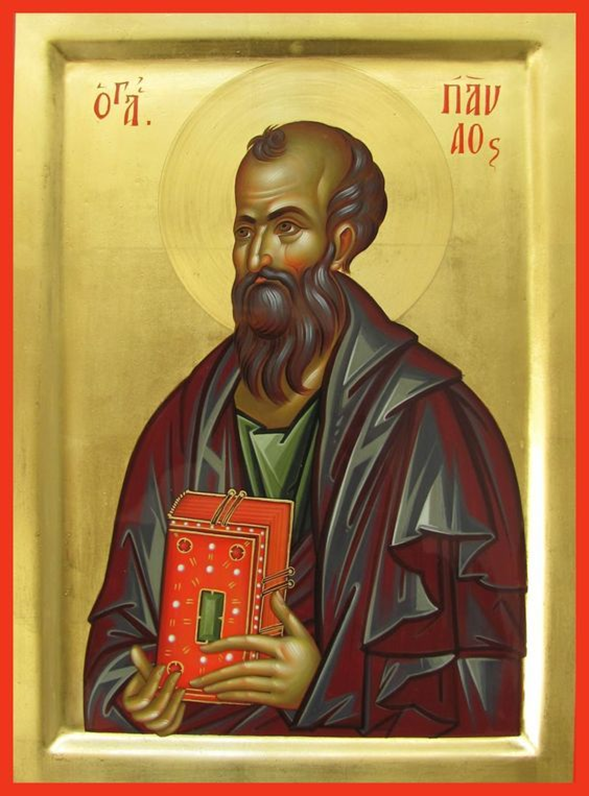
His activity in Philippi, Thessaloniki, and Beroea is also well known. Those who opposed the preaching of the Truth were mainly his fellow countrymen, the Jews, who vehemently resisted God’s call to enter the divine Life of Grace within Christ’s Church.
What happened in Corinth is very characteristic and especially instructive. In the capital of the province of Achaia, Corinth, the Apostle Paul first encountered and joined with Aquila, a Greek-speaking Jew from Pontus, and his wife Priscilla—both evidently Christians—who had been expelled from Rome by an edict of Emperor Claudius the previous year. The Apostle collaborated with this couple also professionally, as they were tentmakers (see Acts, ch. 18).
According to his custom, Paul visited the Jewish synagogue every Sabbath, trying to persuade them through his teaching—as well as the Greek proselytes and pagans—concerning the messianic identity of the Lord Jesus Christ. However, the sacred mission must have faced difficulties, which caused distress to the zealous missionary. The Jews were unwilling to accept the Holy Gospel, and the populous Corinthian crowd, engrossed in daily affairs, captivated by spectacle (the Isthmian athletic games were taking place), and addicted to passionate idolatry, showed indifference toward Christ’s saving message.
At that point, Saints Silas and Timothy, disciples of Paul, arrived from Macedonia. This gave Paul renewed energy, and he strongly affirmed to the Jews that Jesus Christ is the awaited Savior of the world. Yet the Jews persisted in their stubborn resistance to the divine message, even resorting to blasphemy against the Savior Christ. Then Paul shook out his garments in protest and declared the end of his association with them, saying their spiritual ruin was their own responsibility. From then on, he would preach to the Gentiles.
Thus, the Jews’ hostile stance forced Paul to withdraw from them and to state that he was not responsible for the painful consequences of their disbelief: “Your blood be on your own heads!” (Acts 18:6). He who rejects the salvation freely offered is essentially a spiritual suicide—killing himself spiritually! This is a terrible tragedy and destruction.
After this, the Apostle settled in the house of [Titius] Justus, located next to the synagogue, and continued his mission more broadly. Then something unexpectedly remarkable occurred: the leader of the Jewish synagogue in Corinth, Crispus, believed in Christ along with his entire household and left the synagogue. He, the preeminent teacher of the Scriptures, was baptized by Paul himself—something he usually avoided—out of great joy and emotion over such a significant and wondrous conversion.
Among the Gentiles too, Paul’s preaching bore fruit, with many believing and being baptized. However, hesitation returned to Paul due to continued opposition and threats. As he wrote to the Corinthians, he had been among them “in weakness and fear and much trembling” (1 Cor. 2:3). It’s likely that the Jews, especially agitated by Crispus’ conversion, caused serious obstacles to his ministry.
That’s why the Lord Jesus Christ appeared to Paul in an encouraging and strengthening night vision, saying: “Do not be afraid, but speak and do not be silent, for I am with you, and no one will attack you to harm you, for I have many people in this city” (Acts 18:9–10). The Lord emphasized that Paul should not fear threats but teach boldly, for he was under divine protection. No worldly power or enemy could truly harm him, because many people in the city belonged to the Lord and were awaiting Paul’s teaching to believe.
Importantly, the divine reassurance didn’t rule out attempts against Paul but ensured they would not succeed in harming him. In that sinful and irreverent Corinth, many souls were ready to receive the word of salvation, awaiting the divine message to embrace redemption.
Therefore, Paul remained in Corinth for a year and a half, preaching God’s word tirelessly.
His persistent effort for the conversion of the Jews and his profound pain over their refusal stemmed not so much from shared bloodlines as from shared spiritual roots. The God of the Fathers—Patriarchs and Prophets—was the Son of God, Yahweh, the Lord of Glory, who revealed His creative and saving energies to His people during the Old Testament period. He manifested Himself not through His inaccessible essence but through His uncreated glory and energy, speaking with the righteous of His people, giving divine commandments and foreshadowing the mystery of the Incarnation.
He it was who spoke with Moses and the Prophets; He it was who converted Saul the persecutor on the road to Damascus, where Saul had been rushing in fury to persecute Christians (Acts 9:1–18). There, he heard the Lord of Glory—Jesus Christ—but could not see “because of the glory of that light” (Acts 22:11). Blinded, he understood he was fighting the One who had appeared to Moses. To see again, he had to believe and be baptized by the Apostle Ananias.
For this reason, Paul suffered greatly over the unbelief of his fellow Jews, who could not accept faith in Christ because they did not truly seek “the glory that comes from the only God” but pursued human praise among themselves. Therefore, they stood self-condemned. Their accuser was and is Moses himself. The Lord said: “If you believed Moses, you would believe me, for he wrote about me. But if you do not believe his writings, how will you believe my words?” (John 5:44–47).
That’s why Paul wrote so clearly about the Jews: “But their minds were hardened. For to this day, the same veil remains unlifted in the reading of the Old Covenant, because only through Christ is it taken away. But whenever Moses is read, a veil lies over their hearts; but when one turns to the Lord, the veil is removed. Now the Lord is the Spirit, and where the Spirit of the Lord is, there is freedom. And we all, with unveiled face, beholding the glory of the Lord, are being transformed into the same image from glory to glory, just as from the Lord, the Spirit” (2 Cor. 3:14–18).
Acceptance of faith in Christ leads to true understanding and freedom—experiencing the transformative power of Grace. Faith in Christ, when lived out, cleanses, enlightens, and spiritually revitalizes a person, making them a friend of God and a partaker of His glory and Kingdom—even in this life, internally and spiritually, as a foretaste of the future glory and inheritance.
Returning to our narrative, we note that about a year after Paul’s arrival in Corinth, a new Roman proconsul, Gallio—brother of the famous philosopher Seneca—was appointed as governor of Achaia. Then the Jews launched a new assault against the Apostle, but their effort failed (Acts 18:12–17).
In an attempt to exact revenge and prosecute him, they brought Paul before Gallio’s tribunal. They staged a violent and sudden uprising to obtain a conviction and expel him from the city and region. Their accusation was that Paul was persuading people to worship God in a way contrary to the Law of Moses. Unlike past situations in Philippi or Thessaloniki, this was a religious, not a political, charge. The Jews assumed they could secure a conviction since Rome had granted them the right to practice their religion under Mosaic Law.
But Gallio, an experienced and prudent official, deemed it unnecessary even to hear Paul’s defense. He recognized that the case involved no breach of state law or criminal act, but only internal religious matters—something in which he had no desire to interfere.
Thus, he declared himself unqualified to judge the matter and ordered the guards to remove the Jewish accusers from the tribunal. Then the assembled Greeks attacked Sosthenes, the leader of the synagogue, and gave him a thorough beating. Gallio showed no concern for what was happening before him.
This was not an early sign of antisemitism but rather an instinctive reaction of indignation at the malice of the Jewish community’s accusers. The political authority remained indifferent, and the Jews received retribution for their unjust actions from an unexpected source—the Gentiles, who showed sensitivity to justice. From the Apostle and his forgiving followers of the Lord Jesus Christ, they would not have received such vengeance.
The Greeks would have reacted similarly toward anyone behaving as the Jewish leaders did, regardless of ethnic background.
After some time, the Holy Apostle Paul ended his extended stay in Corinth and decided to travel to other areas. From Corinth’s port at Cenchreae on the Saronic Gulf, he boarded a ship bound for Syria, though he ultimately disembarked in Ephesus.
Such was the account of his stay in Corinth during his first missionary journey, which we have briefly reviewed here.
We consider it appropriate to remember, before concluding, that our Holy Orthodox Church, in order to properly frame the issue of relations with religious Judaism, has made Canonical decisions through its Holy and Sacred Synods. These decisions retain their full validity, authority, and force—not only in the past, but also today and always.
Thus, through the 65th Apostolic Canon, the Church proclaims:
“If any Cleric or Layman enters a synagogue of Jews or heretics to pray, let him be deposed and excommunicated.”
There are Holy Canons that forbid all kinds of religious mingling with the Jews (70th and 71st Apostolic Canons, 14th of the Sixth Ecumenical Council, 37th and 38th of Laodicea), especially the joint celebration of the Jewish Passover with the Christian Pascha (7th Apostolic Canon, 1st of Antioch).
Those who violate these canons for the sake of modern social conditions are subject to the penalties of the Holy Canons and, naturally, are not walking according to God, as they are transgressors of Divine Commandments. They are to be avoided and not communed with, and those who follow them bear the same responsibilities.
It should be noted that as human beings, we love and respect all people, regardless of nationality, origin, or religion. We pray for everyone, desire the good of all, and assist all in their need. We make no distinctions in our humanitarian relations or in the scope of our charity and brotherly love. We do not justify any act of violence against them; rather, we fully condemn it.
Only in the case of wrongdoing against us are we collectively obligated to defend ourselves in order to safeguard our sacred traditions and beliefs.
As for the principles of our holy, only-saving, and true Faith—as they have been formulated and lived in the Holy Spirit—we make no concession or deviation, so that we may be shown to be obedient children and be preserved from unpleasant and fateful spiritual and soul-damaging consequences, since:
“Every transgression and disobedience received a just retribution” (Hebrews 2:2).
May the Merciful Lord, Who “wants all people to be saved and to come to the knowledge of the truth” (1 Timothy 2:4), as the Good Shepherd calling all into the divine fold of the Church, deem us worthy to share in the portion of the elect and show mercy to all through repentance—especially the Jewish people, whom He awaits to save in the last times (Romans 11:26), and He has foreordained to accomplish this according to the unfathomable counsel of His divine judgments!
Larissa, June 2025
